Installation of Remembrance
"It is relevant at this point in my career to be showing at the Jewish Museum, touching base with my origins as a Jew," said the American artist Nancy Spero on the occasion of the opening of the "Installation of Memory" at the Jewish Museum Vienna on February 29, 1996.
When Nancy Spero was invited in 1995 to create a permanent installation in the atrium of the Jewish Museum, she already looked back on a long career as a political and feminist artist. The analysis of power relations, war, and oppression, and the role of women across different cultures and eras, were the defining themes of her artistic work. Formally, too, she was constantly searching for new means of expression, developing a distinctive form of collage that combined drawings, photographs, documents, and text.
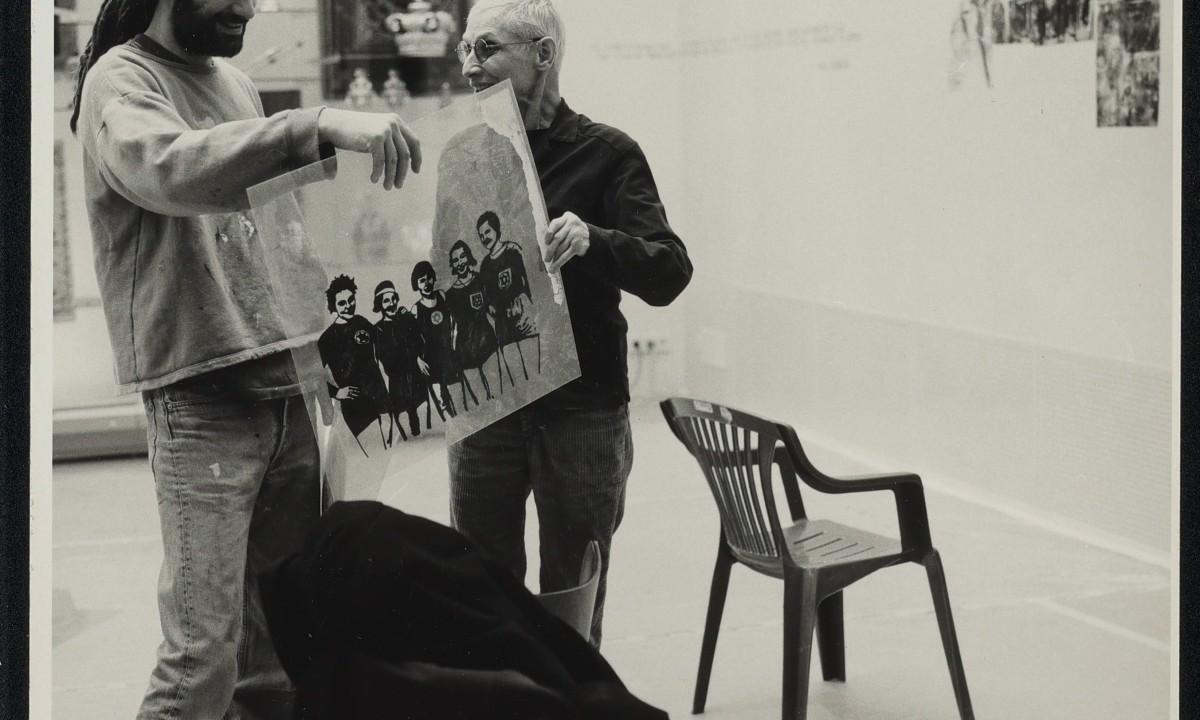
For her project at the Jewish Museum, Nancy Spero worked closely with the museum's curators. They researched historical archives, libraries, and the museum's own collections on her behalf, focusing on three major themes for the installation: the Jewish religion, the history of the Viennese Jewish community before 1938, and the rupture caused by the Shoah. From the material presented to her, the artist selected certain motifs, which she reworked and transferred onto rubber stamps using a special laser process. She then applied the images to the walls of the domed room, which spans two floors.
The choreography of the "Installation of Memory" is only seemingly random, encouraging viewers to form their own associations and immerse themselves more deeply. In selecting historical figures from Viennese Jewish history, Nancy Spero also gave women a prominent place. Thus one encounters the figure of the composer and court opera conductor Gustav Mahler alongside the dancer Hanne Wassermann, the singer and actress Fritzi Massary, and the swimmers of Hakoah Vienna.
An inscription in the room commemorates Max Berger, who collected Judaica in memory of his family, murdered in Auschwitz and Treblinka, and bequeathed the collection to the Jewish Museum. High up at the edge of the dome floats the image of a Hanukkah lamp from his collection.
The Jewish declaration of faith "Shema Israel," which symbolizes the passing on of God's words from generation to generation, is depicted through a text-image based on a bilingual edition by the Viennese rabbi Adolf Jellinek. Jellinek served for many years as a preacher at the Leopoldstadt Temple. Here the circle closes again with images of the destruction wrought by the Shoah, in a depiction of the ruins of what was once the largest Jewish house of worship in Vienna.
I personally remember working with Nancy Spero with gratitude and respect — a woman who seemed so fragile, yet was incredibly strong and creative. She always met us curators and her collaborators as equals, engaged in long discussions, and yet always knew exactly what she wanted.